Oracy
Oracy Curriculum Intent
At Coniston we believe that it is fundamental to give our pupils their own, unique voice. Through explicit oracy teaching, we aim to develop a number of important life skills to prepare them for their transition through primary school and into later life. Pupils will learn to articulate ideas, understand and engage with others, share and challenge the views of their peers thoughtfully and respectfully and showcase the knowledge and skills that they have acquired in each and every lesson. Oracy will underpin our work across the entire curriculum and introduce vital skills needed to interact and develop socially amongst many other benefits including social mobility, academic standards, well-being, self-esteem, confidence and employability. These oracy skills are taught explicitly, practised and then applied independently applied across the school-wide curriculum
Oracy Teaching
Explicit Oracy sessions take place in years 1 to 6 every week and our whole-school curriculum allows for these skills to be regularly revisited in a wide range of contexts. Pupils in Reception are also taught to develop a wide range of oracy skills. However rather than receiving explicit teaching sessions, staff will create and use opportunities that present themselves within pupils’ environment to model and develop specific oracy skills. All oracy teaching uses the oracy framework to focus on four oracy strands: Physical, linguistic, cognitive and social & emotional. The visual below provides further detail on these important areas of oracy development.

Through oracy teaching, pupils work to develop both exploratory talk and presentational talk, both of which we provide numerous opportunities at Coniston for our pupils to practise, improve and master.
Exploratory talk
‘exploratory talk which is typical of the early stages of approaching new ideas Exploratory talk is hesitant and incomplete because it enables the speaker to try out ideas, to hear how they sound, to see what others make of them, to arrange information and ideas into different patterns.’
Barnes, 1992
Presentational talk
‘The difference between the two functions of talk is that in presentational talk the speaker’s attention is primarily focused on adjusting the language, content and manner to the needs of an audience, and in exploratory talk the speaker is more concerned with sorting out his or her own thoughts.’
Barnes, 1992
Oracy Curriculum
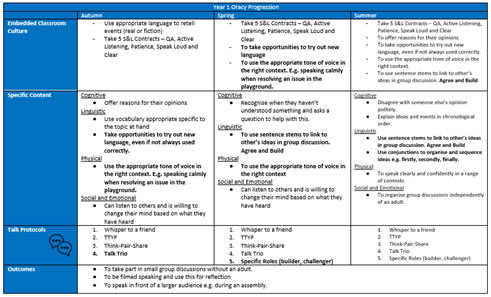
To allow for a wide range of these skills to be taught and practised, we follow our oracy progression document. The document details embedded classroom culture (strategies and skills that pupils use every single day), the specific content that is taught and the range of talk protocols that pupils use to communicate during lessons.
See an example of the Y1 progression below:
Explicit Oracy Teaching
All teachers use the oracy progression document to plan and teach explicit oracy session at least once a week. Some of these objectives are broken down into smaller chunks over a number of weeks and some Sare revisited within the term. Teachers carefully and strategically plan lessons across the wider curriculum to ensure the skills are regularly revisited and built upon across a range of contexts. This is what leads to skills becoming classroom and school-wide culture. In line with our school-wide curriculum, our oracy sessions are also in line with Rosenshine’s Principles of instruction.

Speaking and Listening Expectations
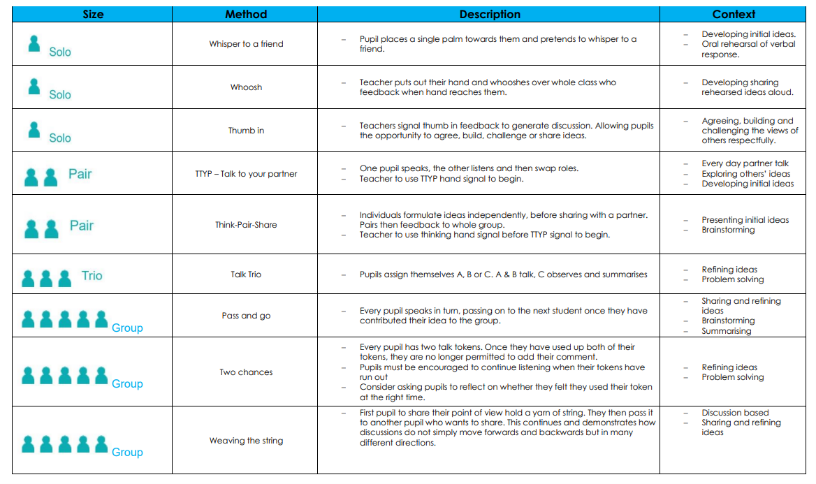
Talk Protocols
From Reception through to Year 6, pupils are taught a range of progressive talk protocols which allow them to orally rehearse and communicate with their peers within small and larger groups. The oracy progression details when children will be taught a range of talk protocols allowing them to become an active participator in discussions. Teachers also use non-verbal signals within the classroom to indicate when these should take place.
Speaking and Listening Contracts
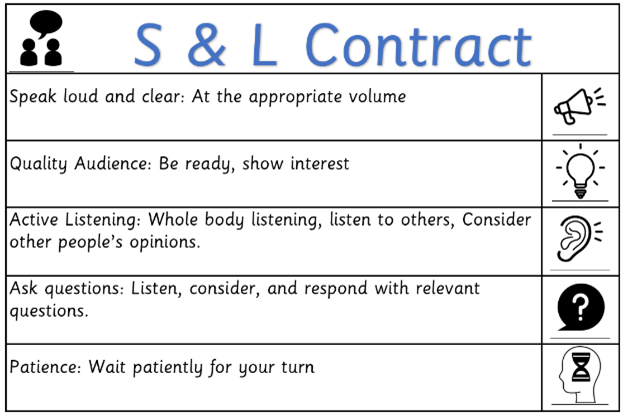
At Coniston, we use a Take 5 speaking and listening contract to set out guidelines and expectations for all pupils when speaking and listening is taking place. Three of these are introduced in Reception, progressing to all 5 becoming classroom culture by the end of Key Stage 1. All pupils are taught to understand the meaning of each rule and sign their name to agree to the contract guidelines at the beginning of each new school year.
Sentence Stems
All classes display sentence stems which allow pupils to scaffold their own talk when sharing ideas, agreeing or disagreeing with others, building on other pupil’s ideas and to asking questions. Teachers will also display subject specific talk stems across the whole curriculum to allow pupils to develop the ability to talk like a scientist, geographer, engineer or mathematician amongst others.
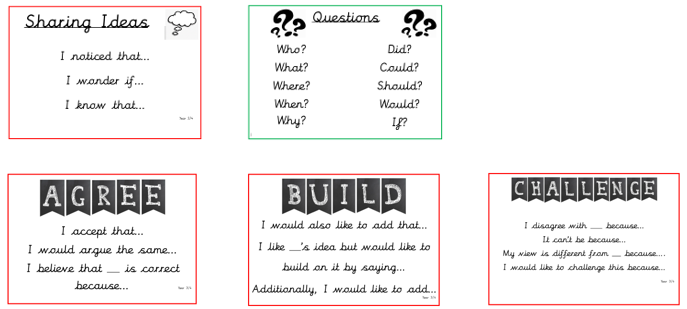
Teachers also use their own individualised sentence and question stems to structure and provide support for pupils during both exploratory and presentational talk. This takes place across all curriculum subjects where pupils are encouraged to talk like a scientist, historian, geographer, engineer etc.