Coniston Primary School
Aspiration, No Excuses, Unity and Excellence

Maths

Our Maths Curriculum

Please download the PDF attachment to find out all about our maths intent and how we build, map teach and assess substantive and disciplinary knowledge within maths.  

Maths Intent

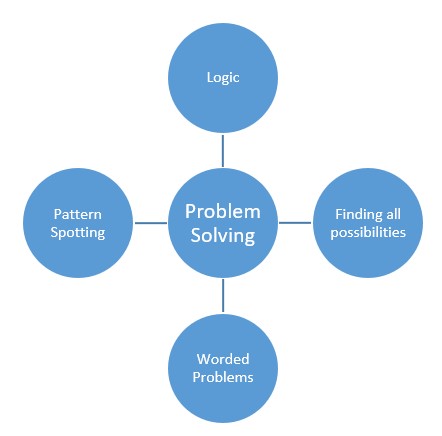
Our aim is for all children at Coniston Primary School to be able to use their mathematical knowledge confidently throughout their lives. They need to be confident in selecting appropriate and effective methods to solve mathematical problems in a variety of contexts. We want all children to enjoy mathematics and to experience success in the subject. This will be achieved through the consistent application of our policies; a weekly diet that consists of varied fluency, reasoning and problem solving; a supportive learning environment that encourages meta cognition and self-regulation and teachers skilled assessment for learning.

Policies

“Mathematical proficiency requires a focus on core knowledge and procedural fluency so that pupils can carry out mathematical procedures flexibly, accurately, consistently, efficiently and appropriately. Procedures and understanding are developed in tandem.”

 NCETM 2014

Downloads:

Maths – Addition Policy

Maths – Subtraction Policy

Maths – Multiplication Policy

Maths – Division Policy

Maths Diet

Sequence of Learning

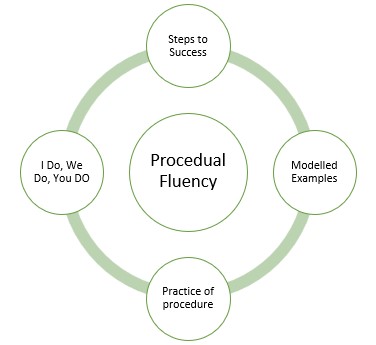
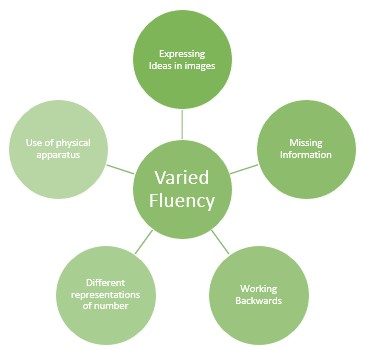
Fact fluency is important as it reduces cognitive overload meaning it will be significantly easier for children to focus on mastering mathematical processes and concepts. We use the Number Sense programme to help children know and remember these facts.  As children learn these facts, they are able to work more proficiently when they learn procedures. Once procedure has been taught and fluency established teachers must challenge the children through teaching with variation or varied fluency. Once the children are able to carry out these procedures accurately, flexibly and consistently the children are then challenged to reason and problem solve within the area of maths where the focus can be on how mathematicians behave through verbal reasoning and problem solving. The ways in which we expect these stages to be taught can be seen below:
Learning Environment

Our maths environment has been designed line with our pedagogical principles outlined in our Teaching and Learning document.  In all classrooms there is a maths learning wall, a maths washing line, maths equipment readily available in answer stations

maths learning walls

Learning Walls

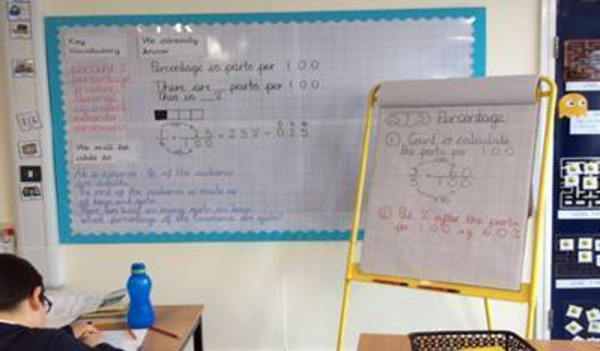
Learning walls grow as the learning progresses, with examples of learning going on the display as they hapen. They show key vocabulary (for unit of work), what we already know (yesterday’s work), today’s learning and an example of what the children will be able to do after the teaching input.

Maths STS

When teaching children, a new procedure, Steps to Success (STS) will be written with the children. Each step will be colour-coded and have a written and visual example. This will then be added to the maths washing line and be a point of reference for the children to access independently. 

washing line

These prompts will be used to support teaching and learning, encouraging children to engage with their environment and the resources and prompts available to them. Practical resources will also be easily accessible and clearly labelled for children to use at all times. 

Resources

Within the classroom, all children will have access to the agreed recourses outlined in our policies.

Answer stations

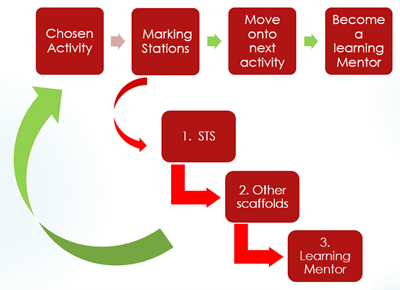
From Year 3 onwards, children are trained to effectively use answer stations. By using these stations children can self-regulate their learning. They are able to move themselves on to more challenging problems and are encouraged to identify their mistakes and misunderstandings and seek a solution to this.

Learning Mentors

The role of the learning mentor is to support children who are still trying to secure their understanding of new concepts and procedures. The will model these procedures for children using the STS in the classroom. They can also use the STS to help the child identify and explain their mistakes.